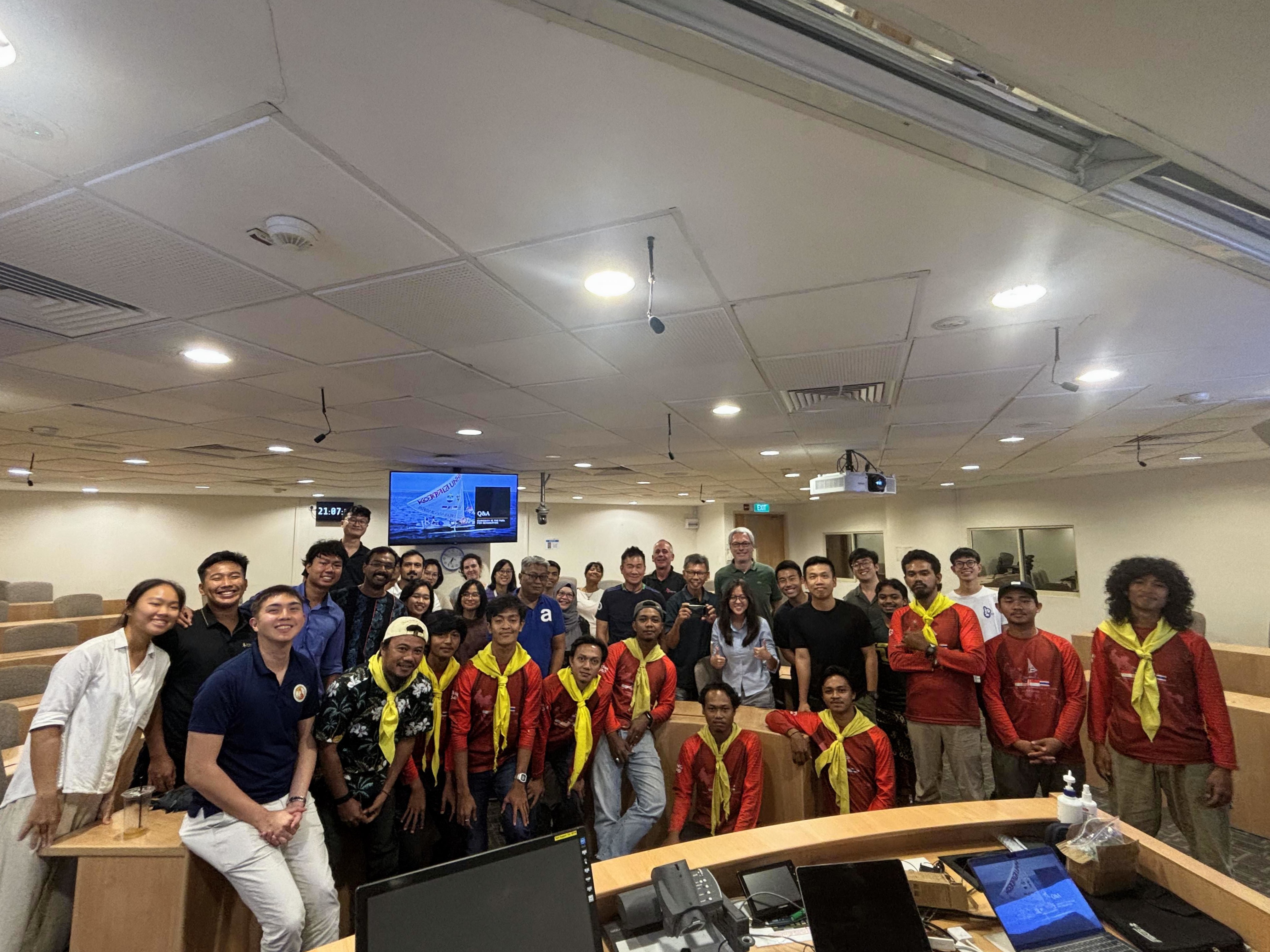
Sandeq Crew Sharing
The following is a transcription of the event.
1. Life at Sea and Mental Preparation
Q: The sea is a hard environment, and your boat is quite small to have so many crew. How do you prepare mentally to sail? How do you sleep, eat, and cook on board?
Sea Trials and Training:
Mental preparation comes from 3 sea trials that simulate long passages.
Crews practice handling obstacles, fatigue, and night sailing during these trials.
Each sea trial get progressively challenging in order to record and plan for the next trial.
Improvements allows them to formulate a plan that best addresses these conditions.
Preparation involves studying weather, tides, and rest cycles. A minimum fitness level is required before undertaking long voyages, hence, physical training is within their regiment.
Local Fishermen knowledge:
Additional knowledge is employed as they learn from local fishermen, who act like guides and share knowledge of landmarks and safe passages. This is adopted into their logs and used as valuable information as reference in local waters.
Sleeping & Eating on Board:
Cooking is done near the bow and mast with the use of a portable gas stove; the mid-rear is used for cargo and for food supplies stored in a wooden crate and enclosed in plastic packages.
Flammables (e.g., oil) are stored separately at the stern for safety purposes. In case of fire, the flammable liquids could be kicked off the stern with ease thus saving the boat. Utensils and tools are kept near the mast area as most boat maintenance happens within that region.
Meals are cooked on small portable stoves.
Typical food includes: Rice (easy to cook, calorie-dense), Keropok, instant noodles (Indomie), Fruits like bananas, though there are limited protein sources.
Supplies:
Water: About 40 litres per trip.
Crew size: Maximum 6 people.
Longest non-stop leg: 26 hours (Belitung to Kalimantan). 300 nautical miles.
Supplies are replenished coastally, as they are never too far away from a coastal settlement where they can replenish food and water from.
While journeys are not exclusively coastal, they usually are. Their voyages are usually held on milder waters and seasons.
Watch cycle:
Two on navigation (helm + spare). Every 4 hour intervals.
Two on cooking.
Two resting.
2. Challenges and Joys at Sea
Q: What is the toughest challenge out at sea? How do you survive?
Coping with fatigue, unpredictable weather, and limited provisions. They will train up before going on the trips to understand their fatigue level better.
Studying local conditions (winds, tides, landmarks) is essential. The winds dictate if the journey intended would be optimised with the currents. They favour a beam reach or downwind angle with the tide behind them. Upwind is unfavoured and avoided entirely where possible, hence their westward legs are more frequent in their course. The northern legs to Malaysia and Thailand would pose the most difficulty.
Q: What is your favourite part of being out at sea? What brings the greatest joy?
Many describe themselves as thrill seekers and nature lovers. More specifically, the crew is from the Nature Lovers Club from their University: Korps Pecinta Alam (Korpala) from Universitas Hasanuddin (UNHAS).
Sailing provides an adrenaline rush similar to extreme sports and testing their mettle against the elements.
Strong sense of ancestral connection: “My ancestors sailed, therefore, I must sail”. The ideological purpose is to celebrate Indonesia’s maritime heritage. The project is intended to unify Indonesians on a common shared heritage of sailing, regardless of the various ethnic groups they belong too.
3. Purpose of the Expedition
Q: What is the purpose of this sailing voyage, and how long has it been going on?
The project has been underway for about six months (one semester). Beginning in Makassar, Sulawesi.
The expedition is slowed because many communities invite them to share stories, lectures, and knowledge. They were happy to go door to door when the places they land in invite them, as they do not have fixed timelines for their expeditions.
They were temporarily stuck in Pontianak due to western/northern winds which would pose an upwind course; their achilles heel.
Purpose
The expedition is this expedition was more than just a physical journey across the ocean in a Sandeq boat, it symbolized the spirit of preserving Indonesia’s maritime cultural heritage. (source)
To remind the younger generation, who no longer actively sail, of their maritime heritage.
To encourage youth to sail, play, and reconnect with ancestral seafaring traditions. “Don’t play on land, play in the sea also”.
Duration so far:
27 days at sea to reach Batam.
Covered 80 miles of territory in a day.
Plan to reach Krabi in 10 days after departing from Batam.
4. Navigation and Safety
Q: Do you use nautical charts or electronic aids to navigation?
Use a combination of:
Traditional local knowledge (landmarks, reference islands). This includes traditional seafaring techniques such as sailing techniques, reading the wind, sea and currents. However, they supplement said traditional techniques with modern technology.
One Garmin InReach Mini, a satellite communicator that allow the crew to keep in touch with people, and send their latest coordinates to them.
Windy app for weather forecasts to determine best launching time and course.
Q: What if you face an emergency?
Does not possess an AIS (Automatic Identification System) due to the expense.
They will use the Garmin InReach Mini to send emergency messages with their coordinates.
Support structure:
Parallel land expeditions travel by road trailing their journey and as replenishment of crew during their switches.
Land teams consolidate information from ports (safe harbours, local knowledge) and pass it to sea teams and also receive information from the sea team such as new problems on the boat or help needed.
They also record damage reports and maintenance needs from the sailing crew and procure those resources to aid them on their next stop.
5. Boatbuilding and Construction
Hull construction process:
-
Construct the keel first. Keel is laid from thick hardwood as a singular piece fresh from the trunk with the grain structure longitudinally oriented for maximum tensile strength.
-
Add the skeleton frame. With ribs of similar hardwood material upright and vertical to the keel in equidistant sections with the sections closest to the mast at higher frequency.
-
Build the hull body. With planking of jati (teak) overlaid onto each other across the ribs held with wooden dowels hammered onto the planks
Materials:
Keel: hardwoods.
Sides & deck housing: Jati (teak).
Mast: bamboo is used as the gandar/mast.
Rituals:
In traditional boatbuilding, the dukun (shaman; sometimes translated as bomoh, though many Malays avoid the term due to its un-Islamic connotations) plays a crucial role. Before the tukang perahu (shipbuilders) cut a tree to shape the vessel’s frame, the dukun seeks permission from the tree. This ritual reflects not modern environmentalism, but rather adat (customary law) and local cosmologies that mandate asking permission from nature or the creator deity before constructing significant objects like ships, especially since offending the spirit of the tree could endanger one at sea. Rituals are often performed under the full moon, in accordance with adat.
Because the tree is regarded as a living being, permission must be ritually obtained before felling it. This worldview is less about ecological awareness in the modern sense, and more about an ontology of interrelations between humans and non-humans. Yet in practice, it imposed cultural “caps” that limited extraction and fostered sustainability.
After the ritual, the main tree is carved into a dugout canoe, with ribs and planks subsequently added. While sources vary, some suggest hardwoods like Ulin (Eusideroxylon zwageri) or Bangkirai (Shorea leavifolia) were traditionally used, though the exact timber for vessels like the Sandeq remains uncertain.
Types of Prahu:
There are 4 types of sandeq boats used to catch fish, namely the Pangoli types with a length 5 to 7 meters, Parroppong and Potangga types with a length 7 to 11 meters and Pallarung types with a length more than 11 meters.
The Sandeq Ekspidasi III commissioned is the Parroppong type.
Sail design:
Formula: Sail slightly longer than the boat (about half a meter extra).
Shape: Square sail with a belly that holds the wind.
Reefing: In upwind, the sail is shortened by pulling a rope from the mast causing the leach to fold inwards. When wind is on a beam, they will ease out the sail more to depower it. In downwind, they can roll up the sail from the mast to make the sail area smaller.
Bamboo is used as the gandar/mast for its high strength to weight ratio. Upright it resist flex with fishing line as shrouds onto the ama’s.
6. Differences Between Vessels
Sandeq:
Small vessel (1.5 - 2 tonnes).
Short-haul, frequent use (e.g., Makassar strait (i.e. between Sulawesi and Kalimantan, and Teluk Mandar (bay of Mandar, where people do some Sandeq racing there). It is also more economically viable.
Developed for gentler western seas.
Too small a displacement for long-haul journeys, as well as weathering the elements
Heritage: possible Austronesian roots, with European influence in the square sail.
Pinisi (Pelari):
Larger vessel (~10 tonnes). Designed for longer hauls in rougher seas. Can carry huge amounts of cargo with significant displacements. Slower and less manoeuvrable Still used in Sulawesi and iconic in Indonesian maritime culture. Currently used as diving liveaboards revived by the dive tourism industry.
Belitung vessel:
Known as a Pacific proa as it catches wind from the windward side which shunts in order to cross the wind from the head. Two hulls, sails unidirectionally with one hull acting as a counterweight to heeling forces which rises above the water.
Comparisons:
Sandeq resembles the Payang boat of Terengganu, Malaysia (similar bow and hull shapes).